

Howard Hughes – the Industrialist, Aviator, and Land Developer- October 28, 2025

Red Stevenson – Pilot, and Aircraft Dealer, Who Became a Bixby, Oklahoma Icon – November 21, 2025
November 21, 2025
Howard Hughes Played The Aviation Chess Game Brilliantly But Lost – December 5, 2025
December 5, 2025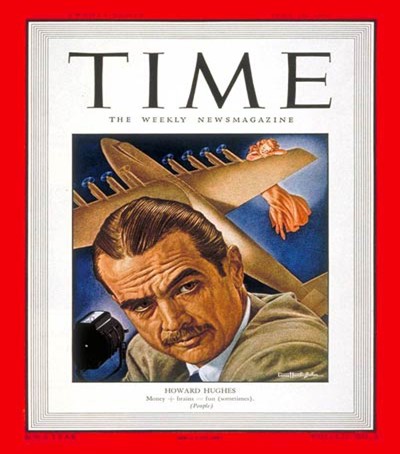
RN3DB
October 28, 2025
Good Morning,
Welcome back to the 3DB and this week I want to clear the air, so to speak, on some of the nonsense that has been written about Mr. Hughes. The movie sensationalized his life, took liberty with some of their facts, and the unauthorized biography was a hoax. So, let’s talk about the legend of the man Hollywood nicknamed “The Aviator.”
Howard Hughes the Man
Howard Hughes (Howard Robard Hughes Jr.) was born in 1905 and died in 1976. His life was controversial, to say the least, and his obsessive-compulsive disorder destroyed his life in later years; however, this article is about his positive contributions and his business skills.
In 1901 the discovery of oil at Spindletop, Texas, near Beaumont, marked the birth of the oil business. Howard’s father moved to East Texas to try his hand at being a wildcatter. Hughe’s father quickly became frustrated by the difficulty of drilling into hard-rock formations with the “fishtail” drill bit that was standard at the time, he devised a superior two-cone bit, which made drilling easier and revolutionized the oil industry. Hughes patented the technology in 1909 and, with partner Walter Sharp, formed the Houston-based Sharp-Hughes Tool Company to manufacture the bit and after Sharp died in 1912, Hughes bought his interest in the company. When Hugh’s father passed away in 1924, his mother had died two years earlier, Howard became a millionaire at the age of 18. Howard dropped out of school, let current management continue running the tool business, and he set out for Hollywood.
Howard had success, and failure, in the movie business. His most famous venture was the movie, “Hell’s Angels,” which was an action-packed adventure about World War I pilots. In order to make the movie as realistic as possible, Hughes amassed a huge fleet of vintage planes and hired scores of pilots and mechanics. He spent nearly $4 million to produce “Hell’s Angels,” which debuted in 1930 and was one of the most expensive films of its time. Three pilots died during production, and Hughes himself crashed a plane. “Hell’s Angels” initially was shot as a silent film, but later Howard decided to reshoot the film with sound. It proved to be a hit with movie goers and put Howard on the map in Hollywood.
Next on his list of accomplishments was to be his numerous aviation adventures. Howard established the Hughes Aircraft Company and set a series of aviation records. In 1935, he broke the record for flying a plane over land, traveling 352 miles per hour near Santa Ana, California. Two years later he set a record for a transcontinental flight from Burbank to Newark. The flight was made in 7 hours and 28 minutes. On July 10, 1938, Hughes and a four-man crew took off from Brooklyn’s Floyd Bennett Field on an around-the-world flight. Hughes made six refueling stops before landing back in Brooklyn where thousands of spectators greeted him. He had set a new record for circumnavigating the globe, with a time of three days, 19 hours and 17 minutes. He was hailed as a hero and honored with a ticker tape parade in New York City and celebrations around the country. The Spruce Goose, and the story around its development and its one successful flight is well known, so I will skip over that as well as his involvement in TWA. If you would like to know more about TWA, Howard Hughes, and Jack Frye please take a minute to read my blog on this. Click HERE and the link will take you there; however, for now I want to tell you about Howard’s work with the CIA which I found on the CIA’s website.
This part of my story begins in 1968 when K-129, a Soviet Golf II-class submarine carrying three SS-N-4 nuclear-armed ballistic missiles, sailed from the naval base at Petropavlovsk on Russia’s Kamchatka Peninsula to take up its peacetime patrol station in the Pacific Ocean northeast of Hawaii. Soon after leaving port, the submarine and its entire crew were lost. After the Soviets abandoned their extensive search efforts, the US located the submarine about 1,800 miles northwest of Hawaii on the ocean floor 16,500 feet below. Recognizing the immense value of the intelligence on Soviet strategic capabilities that would be gained if the submarine were recovered, the CIA agreed to lead such a recovery effort with support from the Department of Defense. CIA engineers faced a daunting task: lift the huge 1,750-ton, 132-foot-long portion of the wrecked submarine from an ocean abyss more than three miles below–under total secrecy.
In 1970, after careful study, a team of CIA engineers and contractors determined that the only technically feasible approach was to use a large mechanical claw to grasp the hull and a heavy-duty hydraulic system mounted on a surface ship to lift it.
The ship would be called the Hughes Glomar Explorer, ostensibly a commercial deep-sea mining vessel ostensibly built and owned by billionaire Howard Hughes, who provided the plausible cover story that his ship was conducting marine research at extreme ocean depths and mining manganese nodules lying on the sea bottom. The ship would have the requisite stability and power to perform the task at hand.
Constructed over the next four years, the ship included a derrick similar to an oil-drilling rig, a pipe-transfer crane, two tall docking legs, a huge claw-like capture vehicle, a center docking well (called the “moon pool”) large enough to contain the hoisted portion of the sub, and doors to open and close the well’s floor. To preserve the mission’s secrecy, the capture vehicle was built under roof and loaded into the ship from a barge submerged underneath. With these special capabilities, the ship could conduct the entire recovery under water, away from the view of other ships, aircraft, or spy satellites.
The heavy-lift operation was complex and fraught with risk. While maintaining its position in the ocean currents, the ship had to lower the capture vehicle by adding 60-foot sections of supporting steel pipe, one at a time. When it reached the submarine section, the capture vehicle then had to be positioned to straddle the sunken submarine section, and its powerful jaws had to grab the hull. Then the ship had to raise the capture vehicle with the section in its clutches by reversing the lift process and removing supporting pipe sections one at a time until the submarine was securely stowed in the ship’s docking well.
Sailing from Long Beach, California, the Glomar Explorer arrived over the recovery site on 4 July 1974 and conducted salvage operations for more than two months under total secrecy–despite much of the time being monitored by nearby Soviet ships curious about its mission. The crew encountered many problems, some serious, but quickly overcame them, and the lift proceeded according to plan. However, when the submarine section was about halfway up, it broke apart, and a portion plunged back to the ocean bottom. Crestfallen, the Glomar crew successfully hauled up the portion that remained in the capture vehicle.
Among the contents of the recovered section were the bodies of six Soviet submariners. They were given a formal military burial at sea and in a gesture of good will, Director of Central Intelligence Robert Gates presented a film of the burial ceremony to Russian President Boris Yeltsin in 1992.
Now, let’s talk about Howard Hughes the Vegas Mogul.
Hughes decided to leave California and move to Las Vegas where he took up residence on the top floor of the Desert Inn; however, when the owners of the hotel tried to kick him out because he was not gambling Hughes decided to buy the hotel. This was great for Vegas because their reputation was that the city was controlled by the Mafia, but now Howard Hughes became the face of Las Vegas. Howard then went on a spending spree after that buying up other hotels and casinos, and vast tracts of undeveloped land. By the early 1970s, Hughes had become the largest single landholder in Nevada, and with around 8,000 Nevada residents on his payroll, Hughes was also the state’s largest employer.
After four years in Vegas Howard left abruptly in 1970 and spent the remainder of his days traveling between hotels at different locations outside the country. In 1976 his aides put Howard on his airplane in Acapulco to go to Houston for medical treatment. Unfortunately, he never made it to Houston but died enroute.
Yes, he was eccentric. Yes, he was reclusive. Yes, he had a mental problem, which I believe contributed to his isolation, and yes he was addicted to pain pills; however, we all have issues but most of us live in anonymity and are not pursed by the press who sensationalize the negative aspects of your personality and the failures you suffer in your day-to-day life.. A sad ending for a man who contributed so much to the success of so many people.
Have a good weekend, keep family and friends close, and remember life is not about money and the stuff you buy…it is about family.
Robert Novell
November 28, 2025
